
Why Most People (Including You) Probably Don’t Need an AI Agent Yet
Lately, whenever I open X, Reddit, or YouTube, I get the feeling that AI agents are about to do everything for us.
They can build an app overnight, run a business, find customers, and even make money while we sleep. It all sounds so good that I want to hand one a laptop and a credit card, then wake up the next morning to see whether I’m a billionaire yet.
I like AI agents too. As someone who builds software, the idea of giving AI a goal and letting it figure out how to complete it is genuinely exciting. I’ve tried using agents for many things, from writing code and researching topics to carrying out workflows with multiple steps.
But the more I use them, the more I notice a strange contradiction: most people probably don’t need an AI agent yet.
At least, not enough to justify building a complicated autonomous system, granting it access to half their digital life, and hoping everything runs smoothly.
Most of Our Work Isn’t That Complicated
Most of my daily work still revolves around email, calendars, documents, spreadsheets, research, and a handful of repetitive tasks.
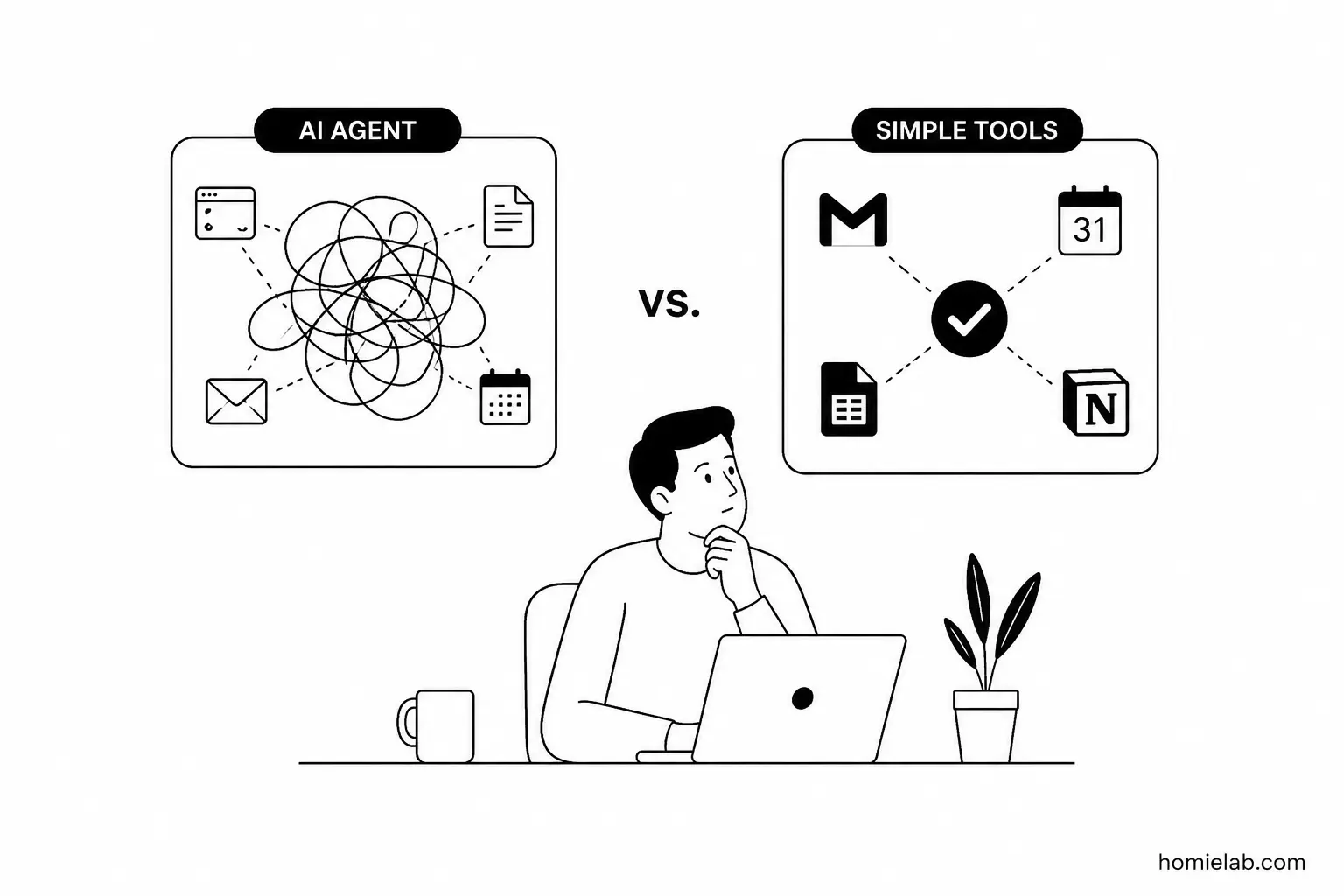
If I want to save email attachments automatically, send a notification when a new order arrives, or create a task on a schedule, a fixed workflow in Zapier, n8n, or the tool I already use is usually enough. It isn’t particularly intelligent, but it is easy to understand: when A happens, do B.
An agent works differently. I give it a goal, and it decides what to do, which tools to use, and which steps to take. That makes it more flexible, but it also creates more opportunities for things to go off course.
Sometimes all I need is for AI to summarize a document. But to do that with an agent, I may have to configure where it gets the file, what it can access, which model and tools it should use, how much it is allowed to spend, and what it should do when something fails. By the end, setting up the worker takes longer than doing the work myself.
Smarter Doesn’t Always Mean More Convenient
A fixed workflow is fairly “dumb.” It only does what I configured it to do. But that is also why I can predict what its next step will be.
An agent is smarter. It can revise its plan as the situation changes, but it can also misunderstand an instruction, forget part of the context, choose the wrong tool, or make one mistake that breaks every step after it.
For example, asking AI to find a suitable flight can be useful. It can search, compare options, and summarize the trade-offs. But there is a big gap between finding a flight and using my card to book it. One wrong date, the wrong baggage allowance, or a missed refund condition can turn convenience into an evening spent calling customer support.
Not every task needs the same level of automation. If AI gets some things wrong, I lose a few minutes fixing the result. If it gets other things wrong, I lose money, expose private data, or affect someone else.
Access Is Part of the Price
For an agent to be genuinely useful, we have to let it see the things we are working with.
To manage a calendar, it needs calendar access. To answer email, it has to read email. To process documents, it needs access to files. To buy something on our behalf, it needs payment information.
The more an agent can do, the more data and authority it usually needs. That doesn’t mean we shouldn’t use agents, but convenience always comes with trade-offs in cost, security, and control.
I often see polished demos of agents completing a task. I rarely see what happens afterward: who checks the result, what happens when an API fails, how anyone notices that the agent sent the wrong email, and who cleans up when it repeats a mistake hundreds of times.
The agent isn’t ultimately accountable. I’m still the one who has to explain what happened when it makes a mistake right before a deadline.
Sometimes a Chatbot Is Enough
I used to think the natural progression of AI was toward as much automation as possible. After using it for a while, I realized that I don’t always want AI to do everything for me.
Much of the time, what I need is simply someone beside me who can:
- read a document with me and identify what matters;
- suggest a few ways to approach a problem;
- write the first draft;
- review a piece of code;
- break a large task into smaller steps;
- point out a perspective I may have missed.
A chatbot that does these things well already saves me a lot of time. I keep control of the decisions, while AI reduces the repetitive reading, writing, and thinking. It feels more like a teammate than an employee with full authority.
If I later notice that a few steps repeat frequently and the results are easy to verify, I can automate those steps. This may sound less impressive than having an army of agents working through the night, but it is easier to control and usually involves fewer creatively broken outcomes to repair.
So When Is an AI Agent Worth Using?
AI agents start to make sense when a task cannot be described with a few fixed rules, requires information from multiple sources, and regularly changes with the context.
For example, an agent can help research a subject across many documents, work through a large codebase, classify inconsistent requests, or prepare several options before a human makes the final decision.
Even then, I prefer to start with a small scope:
- Give the agent one clearly defined job.
- Limit the tools and data it can use.
- Require confirmation before actions that are difficult to reverse.
- Keep logs so I can see what it did.
- Expand its authority only after the results become reliable.
We don’t have to choose between “never use an agent” and “let the agent do everything.” There are many useful levels of automation between those two extremes.
Don’t Chase a Label
AI agents will certainly improve and gradually appear in more of the tools we use every day. At some point, we may be using dozens of agents without caring what they are called, just as most people today don’t care how many APIs an app uses behind the scenes.
For now, if your work only requires a chatbot and a few simple automations, that doesn’t make you a late adopter. The best tool isn’t the one that can do the most by itself. It is the one that solves the problem with the least unnecessary trouble.
For me, AI is most useful when it helps people do better work without taking control away from them.
If a chatbot is enough, use a chatbot. If a fixed workflow already works, there is no need to turn it into an agent just to follow the trend. And if the problem genuinely requires reasoning and adaptation, let an agent take the job-but perhaps keep an eye on it for a while.