Why Most People (Including You) Probably Don’t Need an AI Agent Yet, And That’s Okay
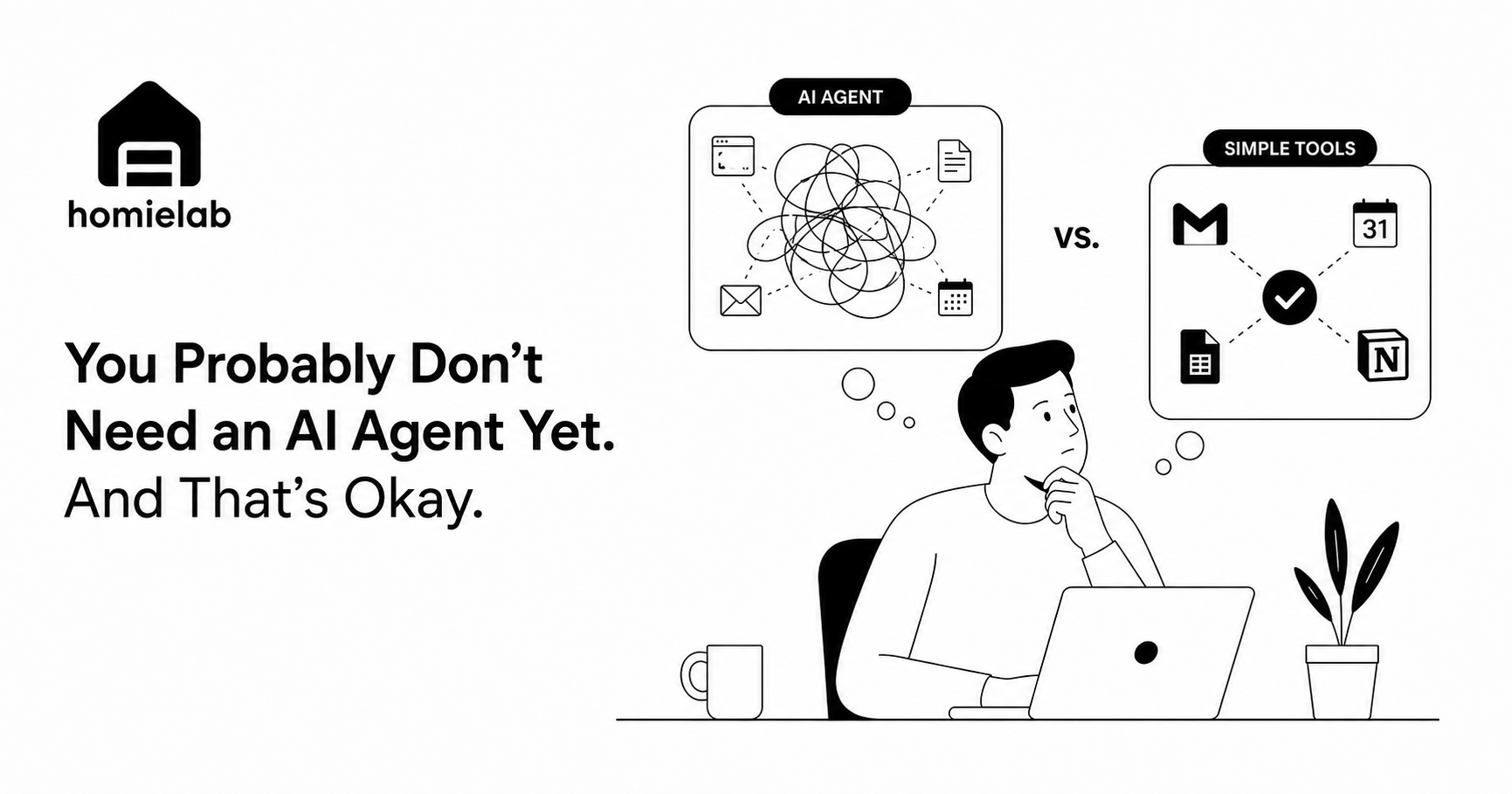
It’s February 2026, and everywhere you look - X, Reddit, YouTube - someone is showing off what their AI agent just did:
- “My agent built an app overnight.”
- “It negotiated $4K off a car.”
- “It runs my whole business while I sleep.”
It sounds incredible. And in some cases, it is.
But if you step back and compare that hype to your actual day-to-day life, a quieter truth starts to emerge:
Most people don’t really need an AI agent right now.
And trying to force one into your routine can actually make things more complicated, not less.
Here are seven practical reasons why skipping the agent wave (for now) might be the smarter move.
1. Your daily tasks aren’t that complex
For most people, work looks like this:
- Sending emails
- Updating spreadsheets
- Booking meetings
- Checking the news
- Organizing notes
These problems were already solved years ago.
Zapier, Google Apps Script, IFTTT, and built-in AI inside Gmail, Notion, and Workspace handle this kind of automation reliably and cheaply. They’re predictable, easy to maintain, and don’t require constant supervision.
An agent might sound more powerful, but in reality you may end up spending more time:
- Tweaking prompts
- Fixing small mistakes
- Reviewing logs
- Re-running failed chains
At that point, you’re managing the agent instead of saving time.
2. Agents still struggle with basic reliability
Even the best setups - Claude-based agents, GPT-powered workflows, or local systems like OpenClaw - can:
- Lose context
- Get stuck in loops
- Misinterpret instructions
- Make small mistakes that cascade
A typical agent chain might look like this:
Research → write report → email it → schedule follow-up
If just one step goes wrong, the entire flow breaks.
For most personal tasks, opening a chat and asking an AI assistant directly is faster, simpler, and requires zero debugging.
3. Cost and security aren’t trivial for casual use
Running an agent locally means:
- Constant CPU/GPU usage
- Higher electricity consumption
- Ongoing API token costs
Even a modest setup can quietly add up to hundreds of thousands of VND per month if it’s running in the background.
Then there’s access.
To be useful, agents often need permissions to:
- Files
- Calendar
- Browser sessions
That opens the door to prompt injection risks. One malicious message or poorly designed tool can trigger unintended actions.
For most people, simpler tools like n8n or Make.com deliver 70–80% of the benefit with far less risk.
4. Most people aren’t building startups in their sleep
The “overnight MVP” stories are exciting, especially for developers and founders. But if your life revolves around:
- A day job
- Family
- Personal goals
- A small side project
You probably don’t need an autonomous system generating products at 3 a.m.
Tools like:
- Notion AI
- Gemini in Workspace
- Claude Projects
- A well-configured ChatGPT setup
already handle research, summaries, planning, and brainstorming extremely well with almost no setup.
5. Predictable workflows often beat “smart” autonomy
Many power users quietly admit the same thing:
For repeatable tasks, rule-based automation wins.
Hard-coded workflows (Zapier, n8n, scripts) are:
- More predictable
- Easier to debug
- Cheaper to run
- More stable long-term
Agents shine when tasks are open-ended and constantly changing.
But most of life isn’t like that.
For routine processes, a simple system plus a touch of AI is often the most effective setup.
6. Full autonomy can reduce your sense of control
There’s a psychological side people don’t talk about enough.
When you hand everything off to an agent, you become dependent on it.
And when it fails, especially right before a deadline, the stress hits harder.
Many early adopters tried fully autonomous setups and then scaled back after realizing:
“I can just do this myself faster and know it’s right.”
AI works best as a co-pilot, not a replacement driver.
7. We’re still early
2026 is likely the decade of agents.
But it may not be the year of agents.
Right now, we’re still in the phase where:
- Demos look amazing
- Real-world reliability is uneven
- Security models are evolving
- Costs are still settling
Agents are already proving valuable in enterprise environments:
- IT operations
- Financial reconciliation
- Support workflows
- Internal automation
For regular everyday use, though, the technology still needs time to mature.
Another 2–3 years could make a big difference.
Bottom line
AI agents are exciting. They’re powerful. And they’re definitely part of the future.
But they’re more likely to shape the future of work than the future of your average Tuesday afternoon.
If you’re deep into:
- Content creation
- Coding
- Research
- Trading
- Scaling a side hustle
Then experimenting makes sense. Running a local setup can be a fun, safe way to learn.
But for everyday life, staying productive without adding stress, a strong chat-based AI plus a few simple automations is already more than enough.
You don’t need to rush.
Save the agent energy for when the experience is truly plug-and-play.
What about you?
Have you tried an AI agent and loved it?
Or tried it and quietly went back to simpler tools?
Or are you happily sticking with the classics for now?
I’d love to hear how it’s working (or not working) in real life.